Posts

#9 – 02/03/17: The Jewish Writings
Image
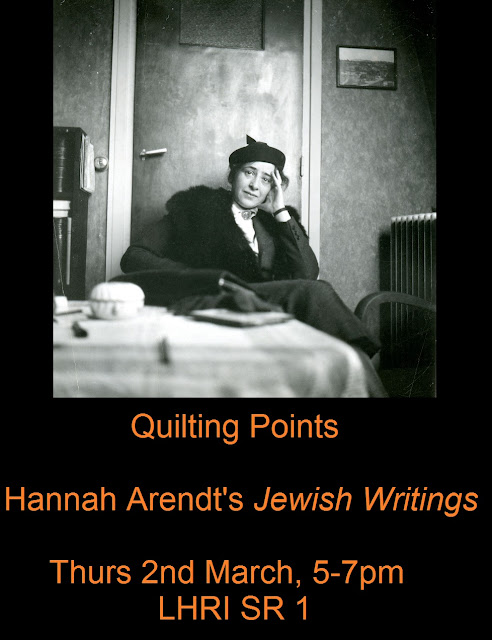
 E ven if the Jews were to win the war, its end would find the … achievements of Zionism in Palestine destroyed … The “victorious” Jews would live surrounded by an entirely hostile Arab population, secluded inside ever threatened borders, absorbed with physical self-defence to a degree that would submerge all other interests and activities. — Hannah   Arendt, 'To Save the Jewish Homeland' In this session we will explore excerpts from Arendt's so-called 'Jewish writings'. Starting with her incendiary essays from the early 1940s, we will trace her development of ideas about the struggle for Jewish emancipation, culminating in the prophetic 'To Save the Jewish Homeland'. These writings bring out some of the questions of political violence and revolution that we have examined in previous sessions. They also document Arendt's views regarding Jewish nationalism as well as the Israel and Palestine conflict (which, by the time of 'To Save the Jewish ...

#8 – 16/02/2017: On Violence

Image
No one engaged in thought about history and politics can remain unaware of the enormous role violence has always played in human affairs. — Hannah Arendt,   On Violence Arendt’s dismissal of African histories, literatures, and languages as nonexistent subjects is troubling. [...] She presents Blacks as trapped in a dream world of escapism and suffering from irrational rage, while desribing a "potentially" violent backlash from the white community as perfectly rational. And as with her analysis of the violence of imperialism/colonialism and the violence of decolonisation, Arendt is far less condemning ofthe oppressors' offensive violence than she is of the defensive violence of the oppressed. —Kathryn T. Gines, Hannah Arendt and the Negro Question Hannah Arendt's On Violence (1970)   is a short but multifaceted text. Pitched as a direct response to the events and debates of the 1960s, Arendt's reflections set out to critique the  escalating civil right...

#7 – 02/02/2017: On Revolution

Image
'In a constellation that poses the threat of total annihilation through war against the hope for emancipation of all mankind through revolution [...] no cause is left but the most ancient of all [...] the cause of freedom versus tyranny.’ Hannah Arendt, On Revolution In our next session we'll be grappling with "The Meaning of Revolution". We'll explore Arendt's challenge to  the Marxist idealisation of the French Revolution, and her argument that we should take inspiration from America instead. Here, Arendt brings her conceptions of freedom and political action to bear, and proposes revolutionary constitutionalism as the means for emancipation. Is this the answer to the question, 'what happens the day after the revolution'?  Where? LHRI, Seminar room 1 When? Thursday, 2nd Feburary, 5-7pm Primary reading: "The Meaning of Revolution", from On Revolution . PDF here .

#6 – Guest speaker Simon Swift presents "Hannah Arendt, Tact and Critical Theory"

Image
In the Jewish tradition there is a concept, hard to define and yet concrete enough, which we know as Ahabath Israel : "Love of the Jewish people..." In you, dear Hannah, as in so many intellectuals who came from the German Left, I find little trace of this. [...] Would there not have been a place [in Eichmann in Jerusalem ] for what I can only describe with that modest German word  – " Herzenstakt "? – – – Gershom Scholem, Letter to Hannah Arendt, June 23 1963 At stake in Arendt’s tactlessness [...] is a crucial, although often unacknowledged strand in her thought as a whole, namely the issue of the relation between politics and feeling.  – – – Simon Swift, 'Hannah Arendt's Tactlessness' Our first session of 2017 will be run by guest speaker Simon Swift, director of the Northern Theory School and Associate Professor of English Literature at the University of Geneva . Simon has published extensively on Hannah Arendt - from articles such as  ...

#5 – 01/12/2016: The Origins of Totalitarianism (2): The Jews and Society

Image
'Comprehension, in short, means the unpremeditated, attentive facing up to, and resisting of, reality––whatever it may be. Hannah Arendt, The Origins of Totalitarianism Our second session on  The Origins of Totalitarianism will grapple with Arendt's investigation into Nazism and the Jewish question. Focusing specifically on Arendt's chapter 'The Jews and Society', we will explore Arendt's conviction that Jews were by no means innocent victims, but rather agents who acted and re-acted within the public realm. This line of thought leads Arendt to a highly controversial question: if Jews were not innocent victims of Nazi violence, then do they in some way share the responsibility for that violence? J oin us for our final meeting before the winter break – expect vegan wine and snacks! Where?:   LHRI, Seminar Room 1  When?:  Thursday 1st December, 5-7pm Primary reading :  Hannah Arendt, 'The Jews and S ociety', in  The Origi...

#4 – 17/11/2016: The Origins of Totalitarianism (1): A Classless Society

Image
'It was characteristic of the rise of the Nazi movement in Germany and of the Communist movements in Europe after 1930 that they recruited their members from this mass of apparently indifferent people whom all other parties had given up as too apathetic or too stupid for their attention.' Hannah Arendt, The Origins of Totalitarianism Next week's meeting is particularly topical given the results of the US election.  It will be the first of our two sessions on  The Origins of Totalitarianism , and will focus on one of the key 'origins' that Arendt identifies: the aspiration towards a classless society. Join us for a thought provoking, and perhaps cathartic, discussion. Where?:   LHRI, Seminar Room 1  When?:  Thursday 17th November, 5-7pm Primary reading :  Hannah Arendt, 'A Classless Society?', in  The Origins of Totalitarianism . Click here  for PDF Secondary reading:  both prefaces to  The Origins of Totalitarianism...

#3 – 03/11/2016: The Human Condition (2): Action

Image
 Hannah Arendt, with few illusions, invites us to think about and live [life] in the present, of course, but always with forgiveness and promise that are the very basis of an optimal political action - Julia Kristeva, Hannah Arendt: Life is a Narrative For our third meeting we'll take a closer look at Arendt's The Human Condition , focusing on how her concept of "Action" is imagined as that which can revitalise the public sphere.  #3 The Human Condition (2): Action, 03/11/2016, 5–7pm Primary reading:  Hannah Arendt, excerpts from 'Action',  The Human Condition (Chicago: Chicago University Press, 1998), pp. 220-247.  Click here for PDF . Location:  LHRI, Seminar Room 1