Posts

Showing posts with the label Judith Butler

#11: Natalia Cecire presents, 'Single Sex: The Queer Poetics of Cell Biology at Bryn Mawr College, 1905'

Image
We are delighted to formally announce that, for our summer term guest talk, we will be joined by Dr Natalia Cecire, lecturer (assistant professor) in English and American literature at the University of Sussex. We are also pleased to say that we'll be hosting this talk in collaboration with the American Studies Research Group, based in the School of English ( https://ahc.leeds.ac.uk/english-research-innovation/doc/american-studies-research-group-1 ).  Cecire's talk draws on Freud's use of nineteenth-century theories of microscopic life in Beyond the Pleasure Principle to situate Marianne Moore's poetics, often described as "shelled" or in various ways hard-surfaced and repelling, in relation to the surprisingly intense research in the biology of sex, inheritance, and generation at Bryn Mawr, the women's college that she attended from 1905 to 1909. Following the Q&A, we will be hosting a wine reception in the School of English.  All students ...

#8: Reading Butler through Berger with Professor Griselda Pollock

Image
Nancy Spero, Performance , 1990 27 March | 5.00 - 6.30pm | Room 1, LAHRI (29-31 Clarendon Place) | All welcome! Guest Seminar from Griselda Pollock, and a Wine Reception We are delighted to announce that, for our final session of the semester, we have invited Professor Griselda Pollock (School of Fine Art, History of Art & Cultural Studies, University of Leeds) to lead us through a reading of Anne Emmanuelle-Berger's The Queer Turn in Feminism: Identities, Sexualities, and the Theater of Gender (2014). In particular, we  will be focusing on the final chapter in Berger's book, 'Roxana's Legacy: Feminism and Capitalism in the West'. Access to the pdf can be found here . In addition to this, Pollock has provided a reading guide to Berger's work, which can be downloaded here . Pollock's guide provides useful theoretical and historical context to Berger's arguments and her source material, so we recommend reading it alongsi...

#3: Symbolic Violence and Language 15/11/18

Thursday 15 November | 5 - 6.30pm | LHRI | All welcome  For our third session of the year, we will be focusing on Butler’s analyses of hate speech, censorship, and ‘obscenity’ in the introduction to Excitable Speech: A Politics of the Performative (1997). Excitable Speech continues Butler’s investigation of subject categories in the context of language and rhetoric. She returns to speech act theories, this time developing questions related to hate speech, injurious name-calling (such as racial slurs or epithets), pornography, rap lyrics, and gay self-expression in the US military – all these topics receive an introductory gloss in this week’s material. Central to her thesis is the rhetorical elision between physical and linguistic injury. Can words wound? How are bodies implicated in, or interpellated by, verbal pain or injury, such as name-calling or legal legislation? Her introduction, and the study as a whole, demonstrates an anxiety about the limits of resignification....

#2: 'Queerness' 25/10/2018

Image
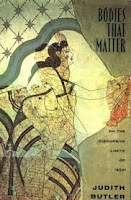
#2: 'Queerness' 25/10/2018 Thursday 25 October | 5 - 6.30pm | LHRI: Room 1 | All Welcome  For our second session of the year, we will be reading the eighth chapter of Butler’s Bodies That Matter (1993), entitled ‘Critically Queer’. We will be reading Butler’s discussion of queer identity, queerness and drag alongside a short section from Maggie Nelson’s The Argonauts (2015). In ‘Critically Queer’, the concluding chapter of Bodies that Matter , Butler evaluates the refunctioning of the term ‘queer’ from its pejorative origins. She urges for the ongoing critique of a totalising queer identity category as ‘crucial to the continuing democratization of queer politics’ (227). If, as Butler argues, a performative discourse succeeds only through its iterability and ongoing citation, then the reification of a queer subject must be interrogated for its own exclusionary practices. The reading for this week allows an investigation of Butler’s claims and a reflection on ho...

Reading Judith Butler

Quilting Points returns for its seventh consecutive year with a new focus on Judith Butler. We are very pleased to announce the return of Quilting Points, an interdisciplinary critical and cultural theory reading group based at the University of Leeds. This year, we will be conducting a year-long discussion on the work of Judith Butler. Since the publication of her first two monographs, Subjects of Desire (1987) and Gender Trouble (1990), Butler’s theories on gender and identity, and power and language, are now widely recognised as cornerstones in the development of contemporary critical theory and philosophy . While Butler’s most notable impact has been in the fields of gender studies, feminist theory, queer theory, and ethics studies, there are few areas in the Humanities left untouched by her work. From her foundational notion of gender performativity to her recent and ongoing work on precarity, Butler’s intellectual range is both established and continually evolving. Ove...